

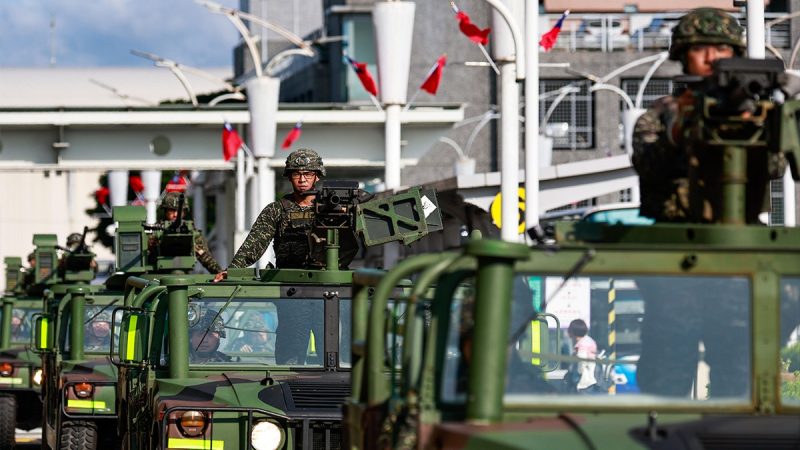
As 2025 ends, tensions between China and Taiwan are higher — and more overt — than at any point in recent years, fueled by expanded U.S. military support for Taipei, increasingly bold warnings from regional allies, and Chinese military drills that look less like symbolism and more like rehearsal.
Beijing has spent the year steadily increasing pressure on Taiwan through large-scale military exercises, air and naval incursions, and pointed political messaging, while Washington and its allies have responded with sharper deterrence signals that China now openly labels as interference.
The result is a more volatile status quo — one where the risk of miscalculation has grown, even as most analysts stop short of predicting an imminent Chinese invasion.
A year of escalating pressure
China capped off 2025 with what it described as its largest Taiwan-focused military exercises to date, launching expansive drills in December that included live-fire elements and simulated island encirclement operations.
The exercises followed a familiar pattern seen throughout the year: People’s Liberation Army aircraft and ships operating closer to Taiwan with greater frequency, reinforcing Beijing’s claim of sovereignty while testing Taipei’s response capacity.
Unlike earlier shows of force, the late-year drills were widely interpreted as practice for coercive scenarios short of outright war — particularly a blockade or quarantine designed to strangle Taiwan economically and politically without triggering immediate global conflict.
Chinese officials explicitly tied the escalation to Washington’s actions, pointing to a massive U.S. arms package approved in December — valued at roughly $11 billion and described as one of the largest such sales to Taiwan in years — as proof of what Beijing calls ‘foreign interference.’
Chinese officials have been unusually blunt in their response.
‘Any external forces that attempt to intervene in the Taiwan issue or interfere in China’s internal affairs will surely smash their heads bloody against the iron walls of the Chinese People’s Liberation Army,’ China’s Taiwan Affairs Office said in a Monday statement.
The arms package continued the U.S. push to strengthen Taiwan’s asymmetric defenses, including missiles, drones and systems designed to complicate a Chinese assault rather than match Beijing weapon-for-weapon.
Taipei welcomed the support but remained cautious in its public response, emphasizing restraint while warning that Chinese military pressure has become routine rather than exceptional.
Japan steps into the frame
One of the most consequential shifts in 2025 came not from Washington or Taipei, Taiwan, but from Tokyo.
In November, Japanese Prime Minister Sanae Takaichi made unusually direct remarks linking a potential Taiwan contingency to Japan’s own security, suggesting that an attack on Taiwan could trigger collective self-defense considerations under Japanese law.
The comments marked one of the clearest acknowledgments yet from a sitting Japanese leader that a Taiwan conflict would not remain a bilateral issue between Beijing and Taipei.
China reacted angrily, accusing Japan of abandoning its post-war restraint and aligning itself with U.S. efforts to contain Beijing. The rhetoric underscored a growing Chinese concern: that any move on Taiwan would draw in a widening coalition of U.S. allies.
That concern has also been reinforced by U.S. treaty commitments to the Philippines, where Chinese and Philippine vessels clashed repeatedly in the South China Sea throughout the year, raising fears of a multifront crisis.
Washington’s deterrence gamble
For the United States, 2025 was defined by a balancing act — reinforcing Taiwan without triggering the very conflict Washington seeks to prevent.
In addition to the December arms package, U.S. officials repeatedly reaffirmed that peace and stability in the Taiwan Strait are vital U.S. interests, while avoiding any explicit shift away from long-standing strategic ambiguity.
The Pentagon’s annual report on China, released late in 2025, reiterated that U.S. defense assessments see the Chinese military developing capabilities that could enable it to fight and win a war over Taiwan by 2027 — a benchmark that has increasingly shaped U.S. and allied planning.
U.S. officials, however, have also cautioned that military readiness does not equal intent, warning against treating exercises or procurement timelines as a countdown clock to war.
Is an invasion coming?
The question hanging over the region — and Washington — is whether China is moving closer to launching a full-scale invasion of Taiwan.
The evidence cuts both ways.
On one hand, the scale and sophistication of Chinese military activity around Taiwan has grown noticeably, with drills emphasizing joint operations, rapid mobilization and isolation of the island. Beijing’s rhetoric has also hardened, portraying reunification as increasingly urgent and framing U.S. involvement as an existential threat.
On the other hand, an amphibious invasion of Taiwan would be among the most complex military operations in modern history, carrying enormous political, economic and military risks for China — whose armed forces have not fought a major war since its 1979 invasion of Vietnam.
Many defense analysts argue that Beijing has strong incentives to continue applying pressure through gray-zone tactics — cyber operations, economic coercion, legal warfare and military intimidation — rather than crossing the threshold into open war.
The December drills reinforced that view, highlighting blockade-style scenarios that could test Taiwan and its partners without immediately triggering a shooting war.
The road ahead
As 2026 approaches, the Taiwan Strait remains a flashpoint where deterrence and coercion are colliding more frequently and more visibly.
The most widely held assessment among U.S. and regional officials is that while the risk of conflict is rising — particularly as China approaches its 2027 military readiness goals — an invasion is not yet the most likely near-term outcome.
Instead, the danger lies in sustained pressure, miscalculation and crisis escalation, especially as more actors — from Japan to the Philippines — become directly implicated in the Taiwan equation.
For now, 2025 ends with no shots fired across the Taiwan Strait — but with fewer illusions about how close the region may be to its most serious test in decades.